The Candidate

As an antidote to the election season, I’d like to share an excerpt from my new suspense/thriller, Mr. Magic. You can read the full-tilt lunacy of the role public relations plays in elections and other marketing campaigns at Amazon, iTunes, Barnes & Noble and Kobo, as well as bookstores everywhere.

Be sure to sign up for the Beyond the Book newsletter, at the bottom of this website’s homepage.

And now, Brinker, the defrocked journalist turned PR whiz, will demonstrate how sausage is made:

On a blustery day in early April, Mary Margaret Paulson stood in an open hanger with the snow swirling like dust devils and gazed at the adoring masses. She looked every bit the presidential candidate. Perfect cheekbones, glossy red lips and a bushel of rich brown hair. Long legs in a black pencil skirt, lacy blouse and a red power jacket with shoulders big enough to carry half the states to the nominating convention.

On the campaign trail she’d been called Chillbilly and Bible Spice for her passionate if uninformed defense of religious freedom. The media mocked her. The pundits hated her. But Brinker knew one thing that many had forgotten: the woman oozed sex from every pore, and men and women alike would sacrifice their firstborn to share the air with her.

The scene resembled a campaign rally. An American flag hung behind two corporate jets emblazoned with the cement company’s logo. Paulson stood on a wooden A-Treat box behind a lectern decorated with patriotic bunting and waved like the queen on parade. A crowd of at least a thousand swelled around her, a line of police officers in reflective vests keeping protesters and supporters on opposite sides of the concrete apron. Sitting in rows of folding chairs under space heaters were local and state dignitaries, representatives from the governor’s office, county council members and the mayors of every city within a fifty-mile radius. The rest of the rabble stood in the cold, their hats declaring allegiance to Garth Brooks, the Phillies and the NRA.

Brinker focused on Paulson’s speech. In an effort to cut costs, the cement company wanted to burn hazardous waste. Residents weren’t convinced by the company’s health studies, which showed emissions would remain below EPA thresholds. His position paper had dealt with the need to balance environmental protection with economic growth. He’d reduced it to three bullet points. Paulson hadn’t gotten through the first when she veered off-message like a bike that had lost its training wheels. She ranted about liberals and intellectuals, the elite and the effete, people who were ruining the country with their bleeding hearts and costly regulations, stifling growth and free enterprise and everything that made America great.

The crowd cheered and Brinker, the PR whiz who’d turned a serial killer into a national brand, started to worry that the stunt wouldn’t backfire, that it wouldn’t create the chaos that guaranteed national coverage. Then, from across the tarmac, he heard the sound of grinding gears and smelled the belch of diesel exhaust as an ancient blue school bus tottered around the corner of the hanger and four dozen Korean woman dressed in hot pink jumpsuits piled out, Buddha at the fore, the notes of Psy’s “Gangnam Style” throbbing from a speaker on the roof.

Buddha, AKA Benjamin Kwon, community organizer and ace travel agent who helped the pursued disappear from the grid. Handing signs to the women—he’d economized by printing both sides, “Feel the Burn” on the front and, on the back, “Burn, Baby, Burn”—he marched the women through the crowd, the Koreans forming a wall between supporters and protesters. As they twirled their signs and waved to the camera, Buddha broke away and headed for the perimeter.

Brinker sidled up to him. “How’s it going?”

“’Oppa oppa Gangnam style.’”

“You should run for office.”

Realizing that reinforcements had arrived, Paulson pointed at the ground with a sharply manicured finger and shouted, “This is it! Right here in little old Allentown, PA! The front lines of the battle, the home of concrete and steel that made this nation great!”

The crowd surged, one half cheering, the other half waving signs mounted on wooden stakes the size of baseball bats. Brinker could smell the blood lust as it raced through them, flaring nostrils, pumping muscles, raking their skin until they began to howl.

The handlers must have felt the massive animal coiling for a strike because two of them flanked the lectern as Paulson finished her speech with the pump of a fist and the cry of “Burn, baby, burn!”

The audience exploded, the police line collapsed. Protesters wielded their signs like clubs. Politicians ducked behind the flag. The cement company’s security force, standing respectfully at attention during the remarks, formed a firewall while the handlers hustled Paulson through the back of the hanger.

As police rushed in with batons, Buddha pulled Brinker to the sidelines. Above the roar of sirens, he said, “We have failed you, my friend.”

Brinker smiled as video crews captured the melee. “It’s all good.”


Atomic shuffle

When we think of vacations, we think of the beach or the mountains, Europe or Mexico, a camper or cruise or condo. But if you’re a travel agent who specializes in helping the hunted drop off the grid, you might look to a few places that, while not off the beaten path, aren’t top destinations for the leisure class.

Think Chernobyl, Fukushima and a place that will keep radiating charm for centuries, Los Alamos and the neighboring town of Alamogordo, site of the Manhattan Project and the testing of the first atomic weapons.

At least that’s what the Korean expat Benjamin Kwon thinks when helping debtors, tax dodgers and advertising agency executives elude official scrutiny. Kwon , AKA the Buddha, does his vanish tricks in Mr. Magic, the second in the series of crime novels featuring a defrocked journalist turned PR whiz named Brinker, who made his debut last year in Mr. Mayhem.

What is it about those three sites that attracts the miscreants, misfits and marketing gurus? For Brinker and Buddha, two words: exclusion zone.

Established soon after the 1986 disaster, the Chernobyl Nuclear Power Plant Zone of Alienation is an evacuation area within a 30 km radius of the Chernobyl Nuclear Power Plant. Decades after the meltdown, residents have crept back into the area.

After the Tōhoku earthquake on March 11, 2011 and the ensuing tsunami, the Fukushima Daiichi nuclear meltdown made that region too hot to inhabit, yet people will always want a closer look at large-scale disaster.

Alamogordo is connected with the Trinity test, the first explosion of an atomic bomb, and the Los Alamos National Laboratory, the secret World War II facility that housed the Manhattan Project.

Dr. Beach isn’t naming any of those sites to his top 10 list of vacation destinations, but any place that’s off limits to the casual visitor might make a good place to hide.

That premise forms the backbone of Mr. Magic, a book that asks the question: how hard must a PR counselor work to spin a visit to a nuclear graveyard as adventure travel? For Brinker, that raises another question: how hard will his new boss at the ad agency press him to exile her rivals to these places?

Brinker will have to use all of the magic he can muster to keep himself from becoming the latest to disappear. You can read all about his struggle to give up sex, drugs and dirty tricks at Amazon, iTunes, Barnes & Noble, Kobo and jeffwidmer.com, as well as bookstores everywhere.

And be sure to sign up for the Beyond the Book newsletter, at the bottom of this website’s homepage.

The Buddha helps people disappear to places like Chernobyl in MR. MAGIC

The Buddha helps people disappear to places like Chernobyl in MR. MAGIC

Off the Grid

Brinker has lost his magic. The agency’s CEO wants him to ace the competition. His former girlfriend wants him in detox. And as rival advertising executives disappear, an ambitious state trooper wants him in jail.

If this keeps up, the PR whiz who turned a serial killer into a national brand may have to vanish himself.

Throw in toxic waste, a nude car wash and a gun-toting presidential candidate and the czar of PR will have to spin some potent magic to escape the snare of sex, lies and greed that threatens to destroy his job, his sanity and the love of his life.

Brinker does so in Mr. Magic, the second in the series of crime novels starring the defrocked journalist. Mr. Magic plays out in the post-industrial snowbelt of Pennsylvania’s Lehigh Valley, an area I know well after working there in marketing for a decade. While Brinker vows to give up drugs and violence, he’s pulled into the netherworld of forced disappearances by a self-styled travel agent who helps clients vanish in places like Fukushima, Chernobyl and the deserts of the American Southwest.

Published by Allusion Books, the novel is the sequel to Mr. Mayhem. Both books are available through Amazon, iTunes, Barnes & Noble, Kobo and jeffwidmer.com, as well as bookstores everywhere. They join the the novels in the CW McCoy series, Peak Season and Tourist in Paradise, that play out in the tony beach towns of Southwest Florida.

And be sure to sign up for the Beyond the Book newsletter, at the bottom of this website’s homepage.

The nuclear reactors at Fukushima

The nuclear reactors at Fukushima

Month of Magic

J.G. Ballard once said that the dystopian landscapes in his books reflect the character’s inner world as much as the outer one.

We’re more familiar with the opposite. Places affect how people feel and act. Think New York in the decade when the city cleaned up graffiti-defaced buildings, repaired windows and installed lighting as part of its crime-fighting strategy.

Pageflex Persona [document: PRS0000030_00049]I’m interested in the collision of those two ideas. In writing fiction, I look for places that both create and reflect a mood. The post-industrial cities of Pennsylvania’s Lehigh Valley provide a wealth of locations that meet that criteria—the ruins of Bethlehem Steel, the abandoned quarries of the Slate Belt, the cement plants near Nazareth.

As you might expect if you read Mr. Mayhem, the novel’s main character, a disgraced journalist called Brinker, thrives in this dystopian world. In Brinker’s second outing, Mr. Magic, the PR whiz who turned a serial killer into a national brand has gone to work for the advertising agency from hell, where the owners have hired him to make the competition disappear.

The Lehigh Valley is the perfect backdrop for the ensuing struggle. From Soldiers and Sailors Monument in Allentown to the historic Moravian settlement in Bethlehem to Route 22 at rush hour, the Lehigh Valley provides both a canvas and a mirror for a character tormented by addiction and failure. (Alert readers will note that while Chernobyl is not a tourist stop in the Lehigh Valley, the location plays a role in the novel.)

Each day next month, I’ll post on social media images of those seminal locations, places that may have become part of your own inner landscape. How many do you recognize?

Corner of Walnut and Main streets in Bethlehem inspired offices of DAR Advertising & PR in MR. MAGIC

Corner of Walnut and Main streets in Bethlehem inspired offices of DAR Advertising & PR in MR. MAGIC


Interior of Crocodile Rock inspired underage pickup scene at Gator Club in MR. MAGIC

Interior of Crocodile Rock inspired underage pickup scene at Gator Club in MR. MAGIC


Across from DAR Advertising stands the majestic Hotel Bethlehem in MR. MAGIC

Across from DAR Advertising stands the majestic Hotel Bethlehem in MR. MAGIC


Carly has her heart set on converting the Moravian Waterworks to a theater in MR. MAGIC

Carly has her heart set on converting the Moravian Waterworks to a theater in MR. MAGIC


In MR. MAGIC, remains of Bethlehem Steel play a role in ad agency’s downfall

In MR. MAGIC, remains of Bethlehem Steel play a role in ad agency’s downfall


Buddha helps people disappear to places like Chernobyl in MR. MAGIC

Buddha helps people disappear to places like Chernobyl in MR. MAGIC


Soldiers and Sailors Monument in Allentown, site of the Hiroshima die-in

Soldiers and Sailors Monument in Allentown, site of the Hiroshima die-in

Thinking Out Loud

I met Anna Quindlen at a video store in Snydersville, PA. We were feeding cassettes into the drop-off box. It was after hours and getting dark. I think I startled her. She used to live in New Jersey and was living in Cherry Valley, not far from my home, near Stroudsburg. Maybe she still lives there.

I worked for the local newspaper. She worked for the New York Times. I’d written a corporate history. She’d won the Pulitzer Prize. Now she writes novels with an eye a detective would envy.

millers-valley-coverMiller’s Valley is her latest book. At times the novel sounds like the saga of the Tocks Island Dam. At times it sounds universal, as if the flooding and evictions take place everywhere, all the time.

In a passage near the center of the book, the narrator, a high-school student named Mimi Miller, is talking to her brother Tommy, who’s just back from Vietnam.

“I didn’t know exactly what Tommy did with himself all day, but he was still in basic-training condition. All the other guys at the VFW had big bellies sloping over their belts. ‘Baby likes beer’ they would say, rubbing their midsections like a genie would show up and they would get three wishes.”

I wish I could write like Anna Quindlen. I wish I could see like Anna Quindlen.

Just thinking out loud.

Month of Mayhem

Next week kicks off a Month of Mayhem, with a look at the places that shaped Brinker’s story in his debut crime novel Mr. Mayhem—all in preparation for the return of the defrocked journalist and PR whiz this fall in the sequel, Mr. Magic.

Brinker returns a kinder, gentler guy who draws inspiration from his girlfriend Carly, a mate he calls The Buddha and the landscapes of the Greater Lehigh Valley. But in the meantime, he’s still stalking the Pocono Mountains of Pennsylvania.

Each day in August, visitors on social media view the scenes that inspired Brinker’s day job and his extracurricular work, as well as the ones that fueled his loves and addictions. Here’s a look at some of the sights that became models for the novel.

1959 Cadillac hearse used by Col. Mabry when the modern version breaks down.

1959 Cadillac hearse used by Col. Mabry when the modern version breaks down.


Stroudsburg, Pa. funeral home that inspired Brinker’s workplace, Mabry & Sons.

Stroudsburg, Pa. funeral home that inspired Brinker’s workplace, Mabry & Sons.


The house on Sarah Street in Stroudsburg, Pa. where Eddie Maps allegedly killed his wife and daughter plays a seminal role in Mr. Mayhem.

The house on Sarah Street in Stroudsburg, Pa. where Eddie Maps allegedly killed his wife and daughter plays a seminal role in Mr. Mayhem.


Corner house in Stroudsburg, Pa. served as a model for the home of the first victim.

Corner house in Stroudsburg, Pa. served as a model for the home of the first victim.


Brinker’s mascot, Pecan Man, haunts Mabry & Sons funeral home.

Brinker’s mascot, Pecan Man, haunts Mabry & Sons funeral home.


One of most famous taverns in the Burgs, Rudy’s served as model for Willy’s Tavern.

One of most famous taverns in the Burgs, Rudy’s served as model for Willy’s Tavern.


Infamous intersection at 7th & Main in Stroudsburg, Pa., host to politicians and fatal accidents.

The intersection at 7th & Main in Stroudsburg, Pa., plays host to politicians and other fatalities.


The Water Gap Trolley became the model vehicle for Brinker’s Magical Murder Tour.

The Water Gap Trolley became the model vehicle for Brinker’s Magical Murder Tour.

The locus of murder

In fiction, when does setting become a character? When does location move from background to foreground?

Readers from Pennsylvania to Florida have called out locales they recognize in both the CW McCoy and Brinker series of crime novels. Even with altered geography and names, those places seem to resonate like the voice of a friend.

As they did with me while doing research for Tourist in Paradise, Peak Season and Mr. Mayhem. Here, then, are some of the images that inspired the characters that inhabit those books. As well as the writer.

Sarasota marina, similar to one where Walter Bishop berths his sailboat in CW McCoy novels

Sarasota marina, similar to the one where Walter Bishop berths his sailboat in CW McCoy novels


Sansara condos in Sarasota, one of models for DeSoto Park complex in “Tourist in Paradise”

Sansara condos in Sarasota, one of the models for the massive DeSoto Park complex in Tourist in Paradise


Farmers Market in downtown Sarasota, where CW and Tony Delgado meet in “Peak Season”

Farmers Market in downtown Sarasota, where CW and Tony Delgado meet in Peak Season


The Sarasota skyline inspired creation of CW McCoy’s Spanish Point

The Sarasota skyline inspired creation of CW McCoy’s Spanish Point


Sarasota Police Dept. inspired Spanish Point’s PD where Cheryl, Oz, Delgado work

Sarasota Police Dept. inspired Spanish Point’s PD where Cheryl, Oz and Delgado work


Drumming the sun down at Siesta Beach, where CW finds second body in “Peak Season”

Drumming the sun down at Siesta Beach, where CW finds a second body in Peak Season


Key Breeze stands in for galley of Mary Beth, where CW finds an unconscious Walter Bishop

Key Breeze stands in for the galley of the Mary Beth, where CW finds an unconscious Walter Bishop in Tourist in Paradise

Darkness descends on the Sunshine State

Someone has declared war on Florida’s tourists. And caught in the crosshairs is CW McCoy, the retired female detective desperately trying to lead a normal life as a real estate agent in tony Spanish Point.

She does, until that someone comes gunning for her.

As if a midnight carjacking isn’t enough trauma, CW must deal with savage punks, corrupt politicians, an errant lover and a disease that is rapidly obliterating her beloved grandfather.

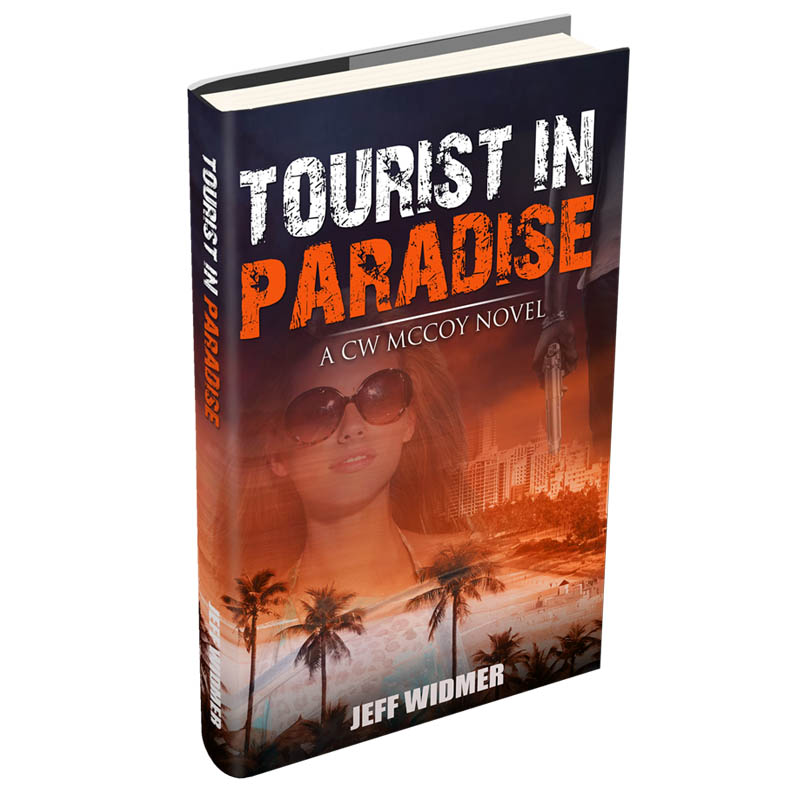
Welcome to Tourist in Paradise, the sequel to Peak Season, the book that kicked off the CW McCoy series of crime novels. The sequel debuted this week in trade paper and ebook formats through Amazon, iTunes and Barnes & Noble. But fans of the spunky sleuth who are eager to read about her troubled past and doubtful future can read the full first chapter of Tourist in Paradise here.

Enjoy.

1.

THE AIR FELT THICK and wet. Lightning slashed the clouds and thunder detonated over the Gulf of Mexico. In the rental lot of the Spanish Point International Airport, palm trees swayed like frat boys. Mercury vapor lights buzzed. The sky dropped another foot.

A hard rain was gonna fall.

By the time Walter Bishop dropped me off at the car rental counter, the display on my cellphone read 12:01 a.m. Despite the hour, the rental agent looked crisp in white shirt and black slacks. Tall, early twenties, with black hair slicked forward in a rapper quiff. His nametag read Ken. No Barbie in sight.

The agent stood at a computer terminal in front of a banner that read, “Spanish Point—Welcome to Paradise.” The photo showed a man in a white shirt, striped tie and madras shorts leaping through the surf with a smiling woman and young girl, both in swimsuits and sarongs. At least the women had dressed the part.

Ken handed over the keys and a copy of the paperwork. “Here you are, Ms. McCoy. You’re in Number Three. Enjoy your stay.”

He smiled. He had a right to look happy. This was Southwest Florida after one of the worst winters on record, when tourists had fled south like refugees. I should have been happy, too, because I’d moved to this beach town two years ago, although trouble with money and men had thrown a bit of sand in my face.

I considered correcting Ken’s assumption that I was a visitor—he should have known, he’d looked at my license—but I kept that thought to myself. Score one for self-restraint.

Walter had the parking lot to himself. Leaning against his gold Mercury Grand Marquis, arms folded, jaws snapping gum, he looked every inch the former state police commander and proud owner of a forty-one-foot sloop. Not exactly your typical beach bum, he still carried a weapon. Louie, his vintage black Labrador Retriever, stood on the passenger seat with his head hanging out the window. All this time in the South and Louie didn’t know better than to wear black.

I walked to slot number three and beeped the remote of a white car that could have passed for a Hyundai, Toyota, Ford or an enameled rickshaw. The front looked like the helmet of an imperial storm trooper. The back bore a Florida license plate.

Walter walked to the car. Last winter, while helping me take down an enraged investor in a bank-fraud scheme, he took a bullet in the thigh. He still walked with a slight limp, but when I’d asked how he felt, he’d always say, “Fine.”

I slid into the seat and started the car. “Why is it that half the rental tags in this state begin with the letter J?”

“They used to begin with Y and Z, until the governor banned the practice.”

“Why?” Even after midnight, the August heat made my clothes feel like a sausage casing. I cranked the knob for AC. The system fought back with a blast of hot air.

“Carjackings and robberies near Miami International.”

I adjusted the mirrors. “How’d that work?”

“Gangs would tail a tourist out of the airport based on stickers and tags. They’d bump the car from behind. Tourist pulls over, puts up a fight, gets popped.” Walter snapped his gum for emphasis.

In the distance, thunder rolled off the horizon. “When was this?”

“Nineteen ninety-two, right after Hurricane Andrew.”

The air blowing out of the vents smelled like the wrong end of a vacuum cleaner. I adjusted the fins and clicked on the headlights.

Walter leaned on the doorframe. “So tell me why you need a rental.”

“I’m showing a house.”

“You always rent cars at midnight?”

The sky crept closer to the ground. I looked for the stalk that controlled the windshield wipers and sighed. “I got a last-minute call to show a condo on Spanish Key and had to return Cheryl’s car. You’d think the cops would let her take a patrol wagon home for the night.”

He crossed his arms and grinned. “You’re diligent.”

“I’m broke, remember?”

“What happened to the SUV?”

“I loaned it to someone.”

“To whom did you loan it?” His grin tempered the mocking tone, but only a bit.

“Chet.”

He smiled to reveal a gap in his top teeth and curled two fingers in a “come on and spill it” gesture.

The car’s clock read 12:06 a.m., the temperature gauge eighty-six. I sighed. “You’re not going to let go of this bone, are you?”

He shook his head.

“Chet, my auto body guy.”

“Ah.” His smile grew wider. “And what did you hit this time?”

“A pole, all right? I was pulling out of the marina lot—you know they won’t let you back in—and this sign came out of nowhere and clipped the bumper. Totally did not look where it was going.”

He laughed and walked to the Merc. “I’ll follow you home. Wouldn’t want you to get ambushed by a traffic light.”

I slammed the door with enough force to fly the rivets back to South Korea and headed down the access road to University Parkway, one of the main East-West highways in Spanish Point. We sailed across the railroad tracks and into the northern part of the city, encountering little traffic at this time and season, when well-heeled residents traveled to cooler climes and the tourists headed back to Canada and the Continent.

The few houses here stood far apart, guarded by cement-block walls with peeling white paint. Not the sign of a prosperous neighborhood. I rarely showed property this far north. The rich retirees preferred gated communities and five-acre ranches east of I-75. I preferred them, too, since I worked on commission.

At the cross street I hung a right onto Orange Avenue and headed south into a fist of rain. Fat drops smacked the windshield, then ratcheted up the volume. I checked the mirror. Walter hung back so far his headlights had disappeared.

The street numbers had dropped from the fifties to the thirties when a car fell in behind me. I glanced in the mirror and saw its glittering image edge closer. When I slowed to let it pass, the car lurched forward and rammed the back of the rental, not enough to set off the airbag but hard enough to jar my teeth.

I jammed the brakes. “What the . . .” I yelled as a black Honda with tinted windows and dual exhaust pipes spun a hundred and eighty degrees and came to rest twenty feet in front of the car, blocking the road and blinding me with its high beams.

A short black kid in a hooded sweatshirt and jeans bounded from the passenger side, raising a handgun as he ran. Hands and eyes, eyes and hands, I reminded myself. Watch the eyes and hands. My heart thundered, my vision narrowing to focus on the weapon. Ducking beneath the dashboard, I searched my ankle for the Beretta .25 only to remember I hadn’t carried since I’d shot that officer in Pennsylvania. I came up to see the black kid pointing the gun at my head and screaming for me to get out of the car.

Things happened fast. I heard Walter yell “Freeze!” and the black kid fired a round that splintered the windshield. Another shot slammed the kid’s shoulder and took him to the pavement. I looked for the driver, a light-skinned male, his features obscured by the blinding headlights. He glanced at his buddy, ground the gears and barreled north, forcing Walter into the ditch.

The kid on the highway rolled in pain. Walter climbed onto the crown of the road and kicked the boy’s weapon out of reach, then backed away and asked, “You all right?”

“Yeah,” I said. My breath felt ragged. I inhaled deeply, willing my heart to slow. “You get the tag?”

“Enough,” he said.

My stomach clenched as Walter moved his gun toward me but he must have changed his mind about asking me to hold the weapon. Flipping open his cell phone, he called 9‑1‑1, asked for police and fire rescue and disconnected.

The kid hugged himself and moaned and rocked on the double yellow line just as the sky opened wide, the rain mixing with blood as it soaked his clothes.

“We need to help,” I said.

With his weapon trained on the boy, Walter tossed his keys to me. “There’s a first-aid kit in the trunk.”

Arms shaking, I grabbed a checkered blanket and red plastic box marked with a white cross and knelt near the boy. He looked about fifteen with a scraggly mustache and a burst of acne on his forehead. With his high top fade, he resembled Will Smith in the “Fresh Prince of Bel Air.”

As shock set in, the kid stopped yelling and stared at me with eyes the size of quarters. Walter had shot him in the meaty part of the right shoulder, as far away from the heart as he could and still hit body mass. I cut away the shirt and, using scissors, tape and a large square of gauze, pressed the makeshift bandage to the wound. He groaned when I tipped him onto his side. The exit wound looked worse. Cutting away the shirt, I stretched the remaining gauze over the hole and taped it to his skin. The patches wouldn’t stop the bleeding but they’d slow it.

Leaning back on my heels, I glanced up at Walter. He stood ramrod straight, gun at his side, a living shadow backlit by the headlights. Between us, rain pelted the pavement, turning the stones to shards of glass.

I bent my head toward the kid. “Why’d you come after us?”

He stared over my shoulder, eyes glazed, blood trickling from a bitten lip. I pulled the blanket over his torso, propped his head on the plastic case and tucked the cloth underneath. Then I backed up to where Walter stood.

“He’s not going anywhere,” I said and heard a faint tremble in my voice.

“Trust but verify.”

“You going to toe him in the ribs to make sure?”

Without taking his eyes from the kid he holstered his gun. “How’s the car?”

“Drivable, if you don’t mind bullet holes.” Rain streamed through my hair and soaked my collar.

He shook his head. “You know what this is about?”

“Robbery for drug money?”

He glanced at me. “Anyone after you?”

I shook my head. “Does he look like a pro?”

“They had to pass me to follow you.”

In the distance, sirens split the air. I leaned against the rental to steady my legs and felt the water soak my pants. “What do you think?”

He stared over my shoulder into the dark. “It’s starting again.”

Dark night of the American Dream

A savage attack. A corrupt politician. A war on tourists . . . and within herself.

CW McCoy faces a barrage of challenges that threaten to overwhelm her in Tourist in Paradise, the sequel to last year’s Peak Season, the novel that marked the debut of the scrappy former detective who battles punks and politicians to head off a full-blown war in Southwest Florida.

Watch the video trailer for the novel here or on YouTube.

[iframe id=”https://www.youtube.com/embed/uTSJZC1PZLo” align=”center” mode=”normal” autoplay=”no”]