Someone has declared war on Florida’s tourists. And caught in the crosshairs is CW McCoy, the retired female detective desperately trying to lead a normal life as a real estate agent in tony Spanish Point.
She does, until that someone comes gunning for her.
As if a midnight carjacking isn’t enough trauma, CW must deal with savage punks, corrupt politicians, an errant lover and a disease that is rapidly obliterating her beloved grandfather.
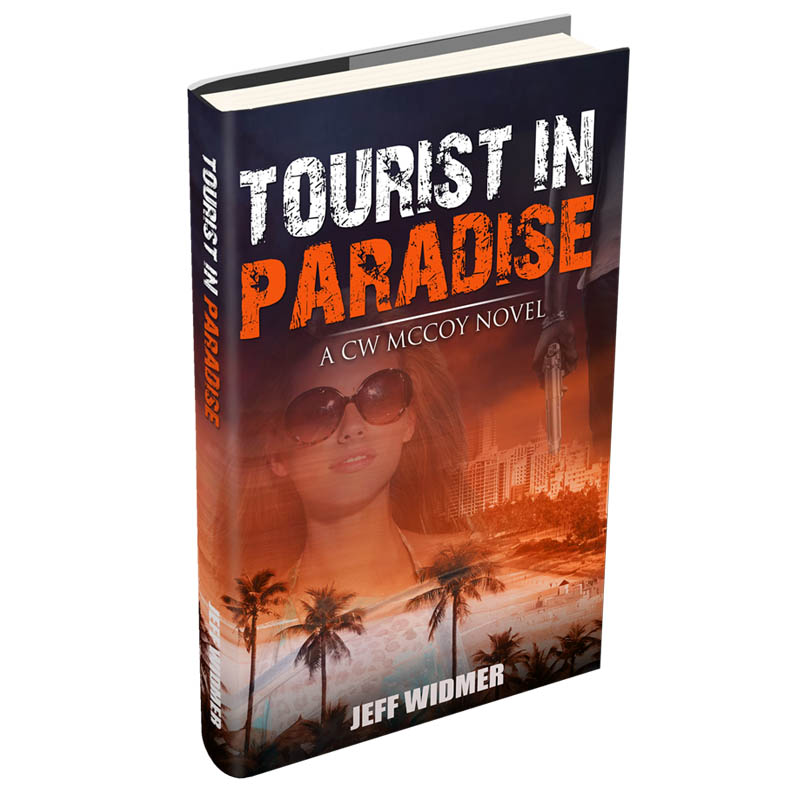
Welcome to Tourist in Paradise, the sequel to Peak Season, the book that kicked off the CW McCoy series of crime novels. The sequel debuted this week in trade paper and ebook formats through Amazon, iTunes and Barnes & Noble. But fans of the spunky sleuth who are eager to read about her troubled past and doubtful future can read the full first chapter of Tourist in Paradise here.
Enjoy.
1.
THE AIR FELT THICK and wet. Lightning slashed the clouds and thunder detonated over the Gulf of Mexico. In the rental lot of the Spanish Point International Airport, palm trees swayed like frat boys. Mercury vapor lights buzzed. The sky dropped another foot.
A hard rain was gonna fall.
By the time Walter Bishop dropped me off at the car rental counter, the display on my cellphone read 12:01 a.m. Despite the hour, the rental agent looked crisp in white shirt and black slacks. Tall, early twenties, with black hair slicked forward in a rapper quiff. His nametag read Ken. No Barbie in sight.
The agent stood at a computer terminal in front of a banner that read, “Spanish Point—Welcome to Paradise.” The photo showed a man in a white shirt, striped tie and madras shorts leaping through the surf with a smiling woman and young girl, both in swimsuits and sarongs. At least the women had dressed the part.
Ken handed over the keys and a copy of the paperwork. “Here you are, Ms. McCoy. You’re in Number Three. Enjoy your stay.”
He smiled. He had a right to look happy. This was Southwest Florida after one of the worst winters on record, when tourists had fled south like refugees. I should have been happy, too, because I’d moved to this beach town two years ago, although trouble with money and men had thrown a bit of sand in my face.
I considered correcting Ken’s assumption that I was a visitor—he should have known, he’d looked at my license—but I kept that thought to myself. Score one for self-restraint.
Walter had the parking lot to himself. Leaning against his gold Mercury Grand Marquis, arms folded, jaws snapping gum, he looked every inch the former state police commander and proud owner of a forty-one-foot sloop. Not exactly your typical beach bum, he still carried a weapon. Louie, his vintage black Labrador Retriever, stood on the passenger seat with his head hanging out the window. All this time in the South and Louie didn’t know better than to wear black.
I walked to slot number three and beeped the remote of a white car that could have passed for a Hyundai, Toyota, Ford or an enameled rickshaw. The front looked like the helmet of an imperial storm trooper. The back bore a Florida license plate.
Walter walked to the car. Last winter, while helping me take down an enraged investor in a bank-fraud scheme, he took a bullet in the thigh. He still walked with a slight limp, but when I’d asked how he felt, he’d always say, “Fine.”
I slid into the seat and started the car. “Why is it that half the rental tags in this state begin with the letter J?”
“They used to begin with Y and Z, until the governor banned the practice.”
“Why?” Even after midnight, the August heat made my clothes feel like a sausage casing. I cranked the knob for AC. The system fought back with a blast of hot air.
“Carjackings and robberies near Miami International.”
I adjusted the mirrors. “How’d that work?”
“Gangs would tail a tourist out of the airport based on stickers and tags. They’d bump the car from behind. Tourist pulls over, puts up a fight, gets popped.” Walter snapped his gum for emphasis.
In the distance, thunder rolled off the horizon. “When was this?”
“Nineteen ninety-two, right after Hurricane Andrew.”
The air blowing out of the vents smelled like the wrong end of a vacuum cleaner. I adjusted the fins and clicked on the headlights.
Walter leaned on the doorframe. “So tell me why you need a rental.”
“I’m showing a house.”
“You always rent cars at midnight?”
The sky crept closer to the ground. I looked for the stalk that controlled the windshield wipers and sighed. “I got a last-minute call to show a condo on Spanish Key and had to return Cheryl’s car. You’d think the cops would let her take a patrol wagon home for the night.”
He crossed his arms and grinned. “You’re diligent.”
“I’m broke, remember?”
“What happened to the SUV?”
“I loaned it to someone.”
“To whom did you loan it?” His grin tempered the mocking tone, but only a bit.
“Chet.”
He smiled to reveal a gap in his top teeth and curled two fingers in a “come on and spill it” gesture.
The car’s clock read 12:06 a.m., the temperature gauge eighty-six. I sighed. “You’re not going to let go of this bone, are you?”
He shook his head.
“Chet, my auto body guy.”
“Ah.” His smile grew wider. “And what did you hit this time?”
“A pole, all right? I was pulling out of the marina lot—you know they won’t let you back in—and this sign came out of nowhere and clipped the bumper. Totally did not look where it was going.”
He laughed and walked to the Merc. “I’ll follow you home. Wouldn’t want you to get ambushed by a traffic light.”
 I slammed the door with enough force to fly the rivets back to South Korea and headed down the access road to University Parkway, one of the main East-West highways in Spanish Point. We sailed across the railroad tracks and into the northern part of the city, encountering little traffic at this time and season, when well-heeled residents traveled to cooler climes and the tourists headed back to Canada and the Continent.
The few houses here stood far apart, guarded by cement-block walls with peeling white paint. Not the sign of a prosperous neighborhood. I rarely showed property this far north. The rich retirees preferred gated communities and five-acre ranches east of I-75. I preferred them, too, since I worked on commission.
At the cross street I hung a right onto Orange Avenue and headed south into a fist of rain. Fat drops smacked the windshield, then ratcheted up the volume. I checked the mirror. Walter hung back so far his headlights had disappeared.
The street numbers had dropped from the fifties to the thirties when a car fell in behind me. I glanced in the mirror and saw its glittering image edge closer. When I slowed to let it pass, the car lurched forward and rammed the back of the rental, not enough to set off the airbag but hard enough to jar my teeth.
I jammed the brakes. “What the . . .” I yelled as a black Honda with tinted windows and dual exhaust pipes spun a hundred and eighty degrees and came to rest twenty feet in front of the car, blocking the road and blinding me with its high beams.
A short black kid in a hooded sweatshirt and jeans bounded from the passenger side, raising a handgun as he ran. Hands and eyes, eyes and hands, I reminded myself. Watch the eyes and hands. My heart thundered, my vision narrowing to focus on the weapon. Ducking beneath the dashboard, I searched my ankle for the Beretta .25 only to remember I hadn’t carried since I’d shot that officer in Pennsylvania. I came up to see the black kid pointing the gun at my head and screaming for me to get out of the car.
Things happened fast. I heard Walter yell “Freeze!” and the black kid fired a round that splintered the windshield. Another shot slammed the kid’s shoulder and took him to the pavement. I looked for the driver, a light-skinned male, his features obscured by the blinding headlights. He glanced at his buddy, ground the gears and barreled north, forcing Walter into the ditch.
The kid on the highway rolled in pain. Walter climbed onto the crown of the road and kicked the boy’s weapon out of reach, then backed away and asked, “You all right?”
“Yeah,” I said. My breath felt ragged. I inhaled deeply, willing my heart to slow. “You get the tag?”
“Enough,” he said.
My stomach clenched as Walter moved his gun toward me but he must have changed his mind about asking me to hold the weapon. Flipping open his cell phone, he called 9‑1‑1, asked for police and fire rescue and disconnected.
The kid hugged himself and moaned and rocked on the double yellow line just as the sky opened wide, the rain mixing with blood as it soaked his clothes.
“We need to help,” I said.
With his weapon trained on the boy, Walter tossed his keys to me. “There’s a first-aid kit in the trunk.”
Arms shaking, I grabbed a checkered blanket and red plastic box marked with a white cross and knelt near the boy. He looked about fifteen with a scraggly mustache and a burst of acne on his forehead. With his high top fade, he resembled Will Smith in the “Fresh Prince of Bel Air.”
As shock set in, the kid stopped yelling and stared at me with eyes the size of quarters. Walter had shot him in the meaty part of the right shoulder, as far away from the heart as he could and still hit body mass. I cut away the shirt and, using scissors, tape and a large square of gauze, pressed the makeshift bandage to the wound. He groaned when I tipped him onto his side. The exit wound looked worse. Cutting away the shirt, I stretched the remaining gauze over the hole and taped it to his skin. The patches wouldn’t stop the bleeding but they’d slow it.
Leaning back on my heels, I glanced up at Walter. He stood ramrod straight, gun at his side, a living shadow backlit by the headlights. Between us, rain pelted the pavement, turning the stones to shards of glass.
I bent my head toward the kid. “Why’d you come after us?”
He stared over my shoulder, eyes glazed, blood trickling from a bitten lip. I pulled the blanket over his torso, propped his head on the plastic case and tucked the cloth underneath. Then I backed up to where Walter stood.
“He’s not going anywhere,” I said and heard a faint tremble in my voice.
“Trust but verify.”
“You going to toe him in the ribs to make sure?”
Without taking his eyes from the kid he holstered his gun. “How’s the car?”
“Drivable, if you don’t mind bullet holes.” Rain streamed through my hair and soaked my collar.
He shook his head. “You know what this is about?”
“Robbery for drug money?”
He glanced at me. “Anyone after you?”
I shook my head. “Does he look like a pro?”
“They had to pass me to follow you.”
In the distance, sirens split the air. I leaned against the rental to steady my legs and felt the water soak my pants. “What do you think?”
He stared over my shoulder into the dark. “It’s starting again.”


![Pageflex Persona [document: PRS0000038_00064]](https://i0.wp.com/www.jeffwidmer.com/wp-content/uploads/2015/06/Peak-Season-flat_cover-360x570-189x300.jpg)
 Jeff Widmer