Back to the Future

Working on Curb Appeal, the third novel in the CW McCoy series (after Peak Season and Tourist in Paradise), I realize that I write backwards.

In school, we learned to organize our material using an outline. I’ve adopted that technique to sort large amounts of material when writing nonfiction. The tool came in handy when I worked for Mack Trucks and had to find a lead buried in hours of interviews. I used a highlighter and flagged passages that were important to the telling of the story, writing subheads for those highlights and prioritizing them so they flowed in a logical way.

Digging out the nuggets from a pile of information seemed a more organic process than writing an outline. The process allowed the structure of the piece to grow from the material, the research and interviews from primary sources. But when it comes to fiction, I seem unable to follow that scholarly advice.

I write backwards.

Yes, I have a solid idea of the nature of the characters and the arc of the story, but I don’t know the exact scope and sequence of the work. I discover that as I write.

And then I write the outline. In fiction, it’s called a synopsis, a summary that’s written with the same flavor as the novel. It’s longer than a logline and shorter than a chapter-by-chapter description of character and action. But, like a GPS device, it can keep me on track.

Do you write forward or backwards?

Behind the scenes

Location plays a vital part in any novel, especially novels of mystery and suspense. I’ve written about place as character several times but now, thanks to author and blogger Lorna Holland of Northamptonshire UK, my musings on crime scenes in sunny Florida have made it to the other side of the pond.

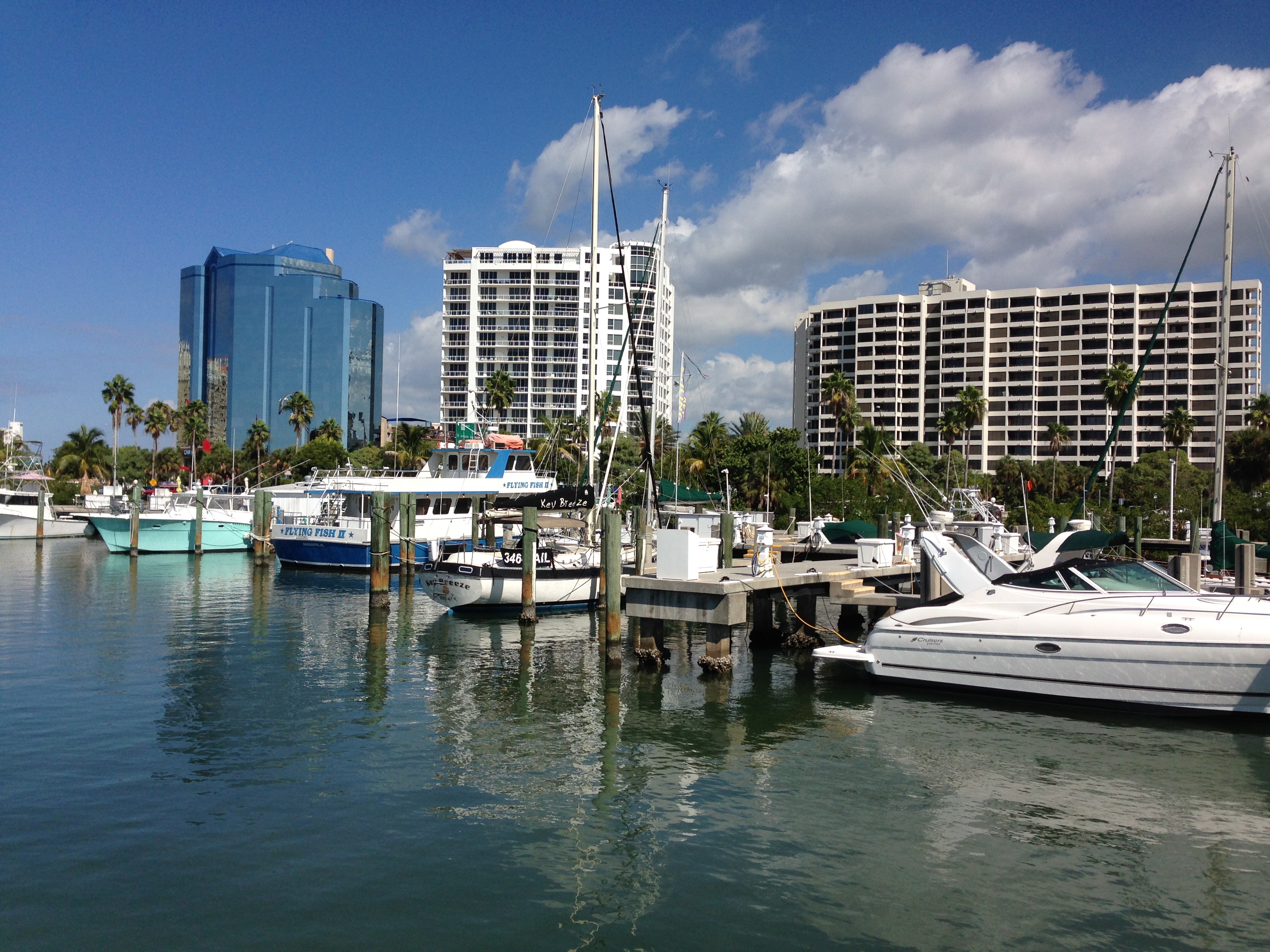
The marina in Sarasota, Florida provided the inspiration for the CW McCoy novels

The marina in Sarasota, Florida provided the inspiration for the CW McCoy novels


The Real McCoy

Many places have informed the CW McCoy crime series. While the books are set in the fictional Florida coastal town of Spanish Point, both Sarasota city and county provided much of the inspiration for Candace and her cast.

Over the past five years, I’ve taken hundreds of photos throughout the region, focusing on the places where CW, Walter Bishop and others might live, work and do their worst. From the office building of One Sarasota Tower to the Sunday night drum circle on Siesta Beach, they illustrate the lives of people struggling to adjust to a changing world. (Full disclosure: I didn’t take the photo of kd Lang, although I did see Tony Bennett in concert at the Van Wezel Performing Arts Center in Sarasota.)

I’ve enjoyed reviewing the images that inspired Peak Season and Tourist in Paradise. I thought you might enjoy them, too.

Tony Bennett and kd lang make their debut in crime fiction in “Peak Season.”


Anna Maria Island City Pier, one of the models for Spanish Point Fish Camp in both CW McCoy novels

Anna Maria Island City Pier, one of the models for Spanish Point Fish Camp in both CW McCoy novels


Mascot of the Sarasota Sheriff’s Office Animal Services unit, Sugar Bear is the model for the abandoned dog in “Tourist in Paradise”

Mascot of the Sarasota Sheriff’s Office Animal Services unit, Sugar Bear is the model for the abandoned dog in “Tourist in Paradise”


Sarasota’s Bayfront Park, where Bobby Lee Darby meets his fate in “Peak Season”

Sarasota’s Bayfront Park, where Bobby Lee Darby meets his fate in “Peak Season”


One Sarasota Tower, model for offices of Mitch Palmer and Casey Laine in CW McCoy novels

One Sarasota Tower, model for offices of Mitch Palmer and Casey Laine in CW McCoy novels


Bradenton Riverwalk, the inspiration for Baywalk in “Peak Season”

Bradenton’s Riverwalk, the inspiration for Baywalk in “Peak Season”

John Ringling’s Cà d’Zan, site of attack on Tommy Thompson’s condo project in “Tourist in Paradise”

John Ringling’s Cà d’Zan, site of attack on Tommy Thompson’s condo project in “Tourist in Paradise”


Darkness descends on the Sunshine State

Someone has declared war on Florida’s tourists. And caught in the crosshairs is CW McCoy, the retired female detective desperately trying to lead a normal life as a real estate agent in tony Spanish Point.

She does, until that someone comes gunning for her.

As if a midnight carjacking isn’t enough trauma, CW must deal with savage punks, corrupt politicians, an errant lover and a disease that is rapidly obliterating her beloved grandfather.

Welcome to Tourist in Paradise, the sequel to Peak Season, the book that kicked off the CW McCoy series of crime novels. The sequel debuted this week in trade paper and ebook formats through Amazon, iTunes and Barnes & Noble. But fans of the spunky sleuth who are eager to read about her troubled past and doubtful future can read the full first chapter of Tourist in Paradise here.

Enjoy.

1.

THE AIR FELT THICK and wet. Lightning slashed the clouds and thunder detonated over the Gulf of Mexico. In the rental lot of the Spanish Point International Airport, palm trees swayed like frat boys. Mercury vapor lights buzzed. The sky dropped another foot.

A hard rain was gonna fall.

By the time Walter Bishop dropped me off at the car rental counter, the display on my cellphone read 12:01 a.m. Despite the hour, the rental agent looked crisp in white shirt and black slacks. Tall, early twenties, with black hair slicked forward in a rapper quiff. His nametag read Ken. No Barbie in sight.

The agent stood at a computer terminal in front of a banner that read, “Spanish Point—Welcome to Paradise.” The photo showed a man in a white shirt, striped tie and madras shorts leaping through the surf with a smiling woman and young girl, both in swimsuits and sarongs. At least the women had dressed the part.

Ken handed over the keys and a copy of the paperwork. “Here you are, Ms. McCoy. You’re in Number Three. Enjoy your stay.”

He smiled. He had a right to look happy. This was Southwest Florida after one of the worst winters on record, when tourists had fled south like refugees. I should have been happy, too, because I’d moved to this beach town two years ago, although trouble with money and men had thrown a bit of sand in my face.

I considered correcting Ken’s assumption that I was a visitor—he should have known, he’d looked at my license—but I kept that thought to myself. Score one for self-restraint.

Walter had the parking lot to himself. Leaning against his gold Mercury Grand Marquis, arms folded, jaws snapping gum, he looked every inch the former state police commander and proud owner of a forty-one-foot sloop. Not exactly your typical beach bum, he still carried a weapon. Louie, his vintage black Labrador Retriever, stood on the passenger seat with his head hanging out the window. All this time in the South and Louie didn’t know better than to wear black.

I walked to slot number three and beeped the remote of a white car that could have passed for a Hyundai, Toyota, Ford or an enameled rickshaw. The front looked like the helmet of an imperial storm trooper. The back bore a Florida license plate.

Walter walked to the car. Last winter, while helping me take down an enraged investor in a bank-fraud scheme, he took a bullet in the thigh. He still walked with a slight limp, but when I’d asked how he felt, he’d always say, “Fine.”

I slid into the seat and started the car. “Why is it that half the rental tags in this state begin with the letter J?”

“They used to begin with Y and Z, until the governor banned the practice.”

“Why?” Even after midnight, the August heat made my clothes feel like a sausage casing. I cranked the knob for AC. The system fought back with a blast of hot air.

“Carjackings and robberies near Miami International.”

I adjusted the mirrors. “How’d that work?”

“Gangs would tail a tourist out of the airport based on stickers and tags. They’d bump the car from behind. Tourist pulls over, puts up a fight, gets popped.” Walter snapped his gum for emphasis.

In the distance, thunder rolled off the horizon. “When was this?”

“Nineteen ninety-two, right after Hurricane Andrew.”

The air blowing out of the vents smelled like the wrong end of a vacuum cleaner. I adjusted the fins and clicked on the headlights.

Walter leaned on the doorframe. “So tell me why you need a rental.”

“I’m showing a house.”

“You always rent cars at midnight?”

The sky crept closer to the ground. I looked for the stalk that controlled the windshield wipers and sighed. “I got a last-minute call to show a condo on Spanish Key and had to return Cheryl’s car. You’d think the cops would let her take a patrol wagon home for the night.”

He crossed his arms and grinned. “You’re diligent.”

“I’m broke, remember?”

“What happened to the SUV?”

“I loaned it to someone.”

“To whom did you loan it?” His grin tempered the mocking tone, but only a bit.

“Chet.”

He smiled to reveal a gap in his top teeth and curled two fingers in a “come on and spill it” gesture.

The car’s clock read 12:06 a.m., the temperature gauge eighty-six. I sighed. “You’re not going to let go of this bone, are you?”

He shook his head.

“Chet, my auto body guy.”

“Ah.” His smile grew wider. “And what did you hit this time?”

“A pole, all right? I was pulling out of the marina lot—you know they won’t let you back in—and this sign came out of nowhere and clipped the bumper. Totally did not look where it was going.”

He laughed and walked to the Merc. “I’ll follow you home. Wouldn’t want you to get ambushed by a traffic light.”

I slammed the door with enough force to fly the rivets back to South Korea and headed down the access road to University Parkway, one of the main East-West highways in Spanish Point. We sailed across the railroad tracks and into the northern part of the city, encountering little traffic at this time and season, when well-heeled residents traveled to cooler climes and the tourists headed back to Canada and the Continent.

The few houses here stood far apart, guarded by cement-block walls with peeling white paint. Not the sign of a prosperous neighborhood. I rarely showed property this far north. The rich retirees preferred gated communities and five-acre ranches east of I-75. I preferred them, too, since I worked on commission.

At the cross street I hung a right onto Orange Avenue and headed south into a fist of rain. Fat drops smacked the windshield, then ratcheted up the volume. I checked the mirror. Walter hung back so far his headlights had disappeared.

The street numbers had dropped from the fifties to the thirties when a car fell in behind me. I glanced in the mirror and saw its glittering image edge closer. When I slowed to let it pass, the car lurched forward and rammed the back of the rental, not enough to set off the airbag but hard enough to jar my teeth.

I jammed the brakes. “What the . . .” I yelled as a black Honda with tinted windows and dual exhaust pipes spun a hundred and eighty degrees and came to rest twenty feet in front of the car, blocking the road and blinding me with its high beams.

A short black kid in a hooded sweatshirt and jeans bounded from the passenger side, raising a handgun as he ran. Hands and eyes, eyes and hands, I reminded myself. Watch the eyes and hands. My heart thundered, my vision narrowing to focus on the weapon. Ducking beneath the dashboard, I searched my ankle for the Beretta .25 only to remember I hadn’t carried since I’d shot that officer in Pennsylvania. I came up to see the black kid pointing the gun at my head and screaming for me to get out of the car.

Things happened fast. I heard Walter yell “Freeze!” and the black kid fired a round that splintered the windshield. Another shot slammed the kid’s shoulder and took him to the pavement. I looked for the driver, a light-skinned male, his features obscured by the blinding headlights. He glanced at his buddy, ground the gears and barreled north, forcing Walter into the ditch.

The kid on the highway rolled in pain. Walter climbed onto the crown of the road and kicked the boy’s weapon out of reach, then backed away and asked, “You all right?”

“Yeah,” I said. My breath felt ragged. I inhaled deeply, willing my heart to slow. “You get the tag?”

“Enough,” he said.

My stomach clenched as Walter moved his gun toward me but he must have changed his mind about asking me to hold the weapon. Flipping open his cell phone, he called 9‑1‑1, asked for police and fire rescue and disconnected.

The kid hugged himself and moaned and rocked on the double yellow line just as the sky opened wide, the rain mixing with blood as it soaked his clothes.

“We need to help,” I said.

With his weapon trained on the boy, Walter tossed his keys to me. “There’s a first-aid kit in the trunk.”

Arms shaking, I grabbed a checkered blanket and red plastic box marked with a white cross and knelt near the boy. He looked about fifteen with a scraggly mustache and a burst of acne on his forehead. With his high top fade, he resembled Will Smith in the “Fresh Prince of Bel Air.”

As shock set in, the kid stopped yelling and stared at me with eyes the size of quarters. Walter had shot him in the meaty part of the right shoulder, as far away from the heart as he could and still hit body mass. I cut away the shirt and, using scissors, tape and a large square of gauze, pressed the makeshift bandage to the wound. He groaned when I tipped him onto his side. The exit wound looked worse. Cutting away the shirt, I stretched the remaining gauze over the hole and taped it to his skin. The patches wouldn’t stop the bleeding but they’d slow it.

Leaning back on my heels, I glanced up at Walter. He stood ramrod straight, gun at his side, a living shadow backlit by the headlights. Between us, rain pelted the pavement, turning the stones to shards of glass.

I bent my head toward the kid. “Why’d you come after us?”

He stared over my shoulder, eyes glazed, blood trickling from a bitten lip. I pulled the blanket over his torso, propped his head on the plastic case and tucked the cloth underneath. Then I backed up to where Walter stood.

“He’s not going anywhere,” I said and heard a faint tremble in my voice.

“Trust but verify.”

“You going to toe him in the ribs to make sure?”

Without taking his eyes from the kid he holstered his gun. “How’s the car?”

“Drivable, if you don’t mind bullet holes.” Rain streamed through my hair and soaked my collar.

He shook his head. “You know what this is about?”

“Robbery for drug money?”

He glanced at me. “Anyone after you?”

I shook my head. “Does he look like a pro?”

“They had to pass me to follow you.”

In the distance, sirens split the air. I leaned against the rental to steady my legs and felt the water soak my pants. “What do you think?”

He stared over my shoulder into the dark. “It’s starting again.”
Dark night of the American Dream

A savage attack. A corrupt politician. A war on tourists . . . and within herself.

CW McCoy faces a barrage of challenges that threaten to overwhelm her in Tourist in Paradise, the sequel to last year’s Peak Season, the novel that marked the debut of the scrappy former detective who battles punks and politicians to head off a full-blown war in Southwest Florida.

Watch the video trailer for the novel here or on YouTube.

[iframe id=”https://www.youtube.com/embed/uTSJZC1PZLo” align=”center” mode=”normal” autoplay=”no”]

Sequel exposes dark side of tourism in Florida

If tourism is the lifeblood of Florida, the killers in Tourist in Paradise are intent on draining the state dry. Whether they succeed depends on a female sleuth who moved to the Sunshine State to escape this kind of violence.

What CW McCoy finds is a tsunami of corruption and deceit as she battles punks and politicians in the second in the McCoy series of mystery/suspense novels.

TIP covers top bookThe stakes are high for residents of the fictional city of Spanish Point, a tony resort town located between Tampa and Naples on Florida’s Gulf Coast. When a gunman mistakes CW for a wealthy tourist, the real estate agent is thrust into a series of crimes that pit visitor against visitor. Is the violence the start of a full-blown war on tourists? Or are the attacks a smokescreen for an even greater threat?

And if CW unmasks the killers, will it spell the end of her career, her friends and her life?

Published by Allusion Books, Tourist in Paradise is the sequel to Peak Season, a book Kirkus Reviews calls “an entertaining mystery romp.” The crime novel is available through Amazon, iBooks and Barnes & Noble in both e-book and trade paperback formats. Readers can view the book trailer at jeffwidmer.com or YouTube.

Fans of Janet Evanovich, Robert B. Parker, Ruth Rendell and Chelsea Cain should enjoy the book.

I hope you’re one of them.

Beach-town thriller ‘Peak Season’ debuts in audio

I heard CW McCoy before I saw her face.

The heroine of my first crime novel was listening to a fugitive con artist make the case for clearing his name. CW did what I bet most former police officers would do: she kicked the guy to the curb.

Feisty, I thought, from the low, smooth voice to the Spenser-like banter. Maybe I should take notes.

I did, and the result was Peak Season, a novel set in the tony Florida beach town of Spanish Point. The work came out this summer in ebook and paperback formats. And while that satisfied my itch for publication, I kept hearing the dialog and realized CW wanted her own voice.

She has finally gotten it. After months of preparation, Peak Season is now available as an audiobook through Amazon, Audible and iTunes. The recording sounds just as I envisioned it, thanks to the powerful narration by Pamela Almand, who captures CW’s grit as well as the nuanced voices of her mentor, friends and enemies.

At first I had some doubts. Everyone said that writing from a woman’s point of view would prove challenging. So it felt like a victory to hear Pam bring the fellow risk-taker to life. CW may surrender her gun and badge but she will never surrender her spirit, and Pam’s rich tone and nuanced reading make that spirit sound very real.

If you’re a fan of Lorelei King’s wonderful rendition of the Stephanie Plum books, you’ll enjoy Pam Almand. It’s a voice that will ring in your ears long after she turns the last page.

You can listen to a free excerpt of Peak Season at Audible or iTunes.

Peak Season Audible

Summing up summaries

Writing the book was easy. Writing the synopsis was a bear.

You’d think that, after investing the better part of a year in my characters, I could crank out a summary as easily as ordering at McDonald’s. Not so for Peak Season, the first in a series of crime novels featuring the former cop turned pacifist Candace McCoy, known to her friends as CW.

Peak Season 3D cover 375x548Even after writing headlines at a daily newspaper for 14 years, I couldn’t distill the essence of the book. Should I focus the synopsis on the plot? On the characters? What if the plot arcs like a roller coaster, and the characters reject their labels? Fanciful but not helpful. Agents want to read a clear, concise summary of the book. They won’t appreciate digression.

I went at it draft after draft, pulling a few characters and themes from the wreckage. Eventually the copy wound up on the back cover of the novel. Here’s the synopsis. I’d be interested in hearing what you think. You can reach me through the comments section or the email link on the bottom of the website’s homepage.

Peak Season synopsis
Life at the beach can be murder.

Forced to shoot a fellow police officer, CW McCoy surrenders her gun and her badge to take refuge in the wealthy tourist mecca of Spanish Point, Florida. There she pedals luxury real estate, cares for her ailing grandfather Pap and tries to escape her past.

But even in paradise during peak tourist season, violence finds her like a divining rod.

Declared dead by the courts, Bobby Lee Darby bursts into CW’s office to demand the family friend clear his name in a scheme to bilk millions from investors. When CW refuses, the fugitive financier kidnaps Pap to ensure her cooperation, triggering a chain of burglary, assault and murder that convinces local police that the former cop has gone rogue.

Racing to find Darby, CW must confront her violent past, risky affairs and love-hate relationship with Southwest Florida before those personal demons turn her new-found paradise into hell on earth.

Judging a book by its cover

I remember the day it it finally arrived . . . the cover for the Kindle version of Peak Season, the first in the CW McCoy series of crime novels. With its palm-tree sunset and police motif, the artwork reflected the setting and theme of the book—the fictional city of Spanish Point and the dilemma narrator CW (Candace) McCoy faces in her new life: how to live in peace while surrounded by violence.

Pageflex Persona [document: PRS0000038_00064]Here she is, working in a resort town in Florida, selling beach homes to the uber-rich, sailing with a former police commander and kayaking with a hunk who manages more money than the Philadelphia Mint. Paradise by most standards. If it weren’t so dangerous, she’d find the situation ironic.

That’s a lot to ask a designer to convey. Even more taxing is translating emotional nuance into something people can see.

I know, I’ve tried. Back when I made my living as an art director as well as a writer, I designed the cover and interior of my first published work of nonfiction, the Spirit of Swiftwater. It proved challenging but fun. I selected objects that embodied the theme, hired a terrific photographer (David Coulter), designed the cover in Quark and handed the whole thing to the printer.

Fast forward a dozen years to a technology that has outrun my ability to comprehend it. The applications are new and utterly complex. I tried designing a cover for Peak Season in Photoshop and cringed. Time to get professional help.

I found Rick Smith’s how-to book CreateSpace and Kindle Self-Publishing Masterclass on Amazon and followed it to a site called Fiverr. There I found a person in Bulgaria who created a design that’s provocative, attractive and professional.

But it’s your opinion that counts. Can you judge a book by its cover? Has a cover ever made you want to read a book?

Hook, line and action scene

David Hagberg doesn’t mess around. During a workshop in Venice, Florida, he said genre writers have to hook readers early, and the best way to do that is with action. He should know. He’s written a dozen thrillers for TOR.

After the session, I said I couldn’t decide how to begin Peak Season, a crime novel set in the fictional Florida beach town of Spanish Point. Should I start with the inciting incident, the one that drags the protagonist, CW McCoy, into the action? Or should I start with the scene that caused her to lose her gun, her badge and her self-confidence, the incident that propelled her to take refuge in this resort town by the sea?

In that big, bellow of his Hagberg said, “Start with the action!” I think people from Tampa to Naples heard him. I certainly did.

Was he right? Take a look at the first few pages of the novel and tell me what you think. (You can reach me through the email link at the bottom of this website’s homepage.)

1.

I spotted the gun as soon as I walked through the door. Nicholas Church aimed a Glock 22 at his wife and daughter, arms straight and locked, his finger touching the trigger. His wife’s hands held nothing but air. The daughter gripped the back of her mother’s dress. Church’s eyes looked hard, the wife’s anguished, the little girl’s wide with terror.

“Bitch!” he roared and the soGun range silhouetteund echoed throughout the dead kitchen.

My face burned. After leaning out to call for backup, I stepped fully into the room and identified myself. He knew me. We’d worked together for two years. I held my hands away from my holster where he could see them. Non-threatening. No show of force. Talk him down.

Church filled the kitchen. He stood over six-feet-six and weighed more than 250 pounds, black hair slicked back, khaki slacks still creased despite the hour, white shirtsleeves rolled to the forearms to reveal a blue Marine Corps tattoo nestled among a thatch of hair. Under the fluorescent lights his silver badge glowed. Two years ago he’d received a citation for rescuing a woman trapped in a car. A year later the department had placed him on leave for beating a suspect during a drug bust. The wounded hero.

At five-foot-five, Anita Church shrank before her husband. She looked mid-twenties with a sharp nose and wisps of blond hair that floated around dangling earrings. She wore a sundress of pale yellow and blue, belted at her slender waist, and ballet shoes. Her wedding and engagement rings sparkled, as if to mock Church’s badge. When I moved closer, she glanced at me as if to say, you’re a woman, you can save me, and reached behind to clutch her daughter.

The girl was maybe seven, dressed in jeans and a sparkling pink T-shirt that depicted one of the Disney princesses. She wore pink slippers with rabbit ears. Junie, I thought. Nick called her June Bug.

For the third time that night I reminded myself that I didn’t belong there. Patrol responded to domestics, not detectives. My luck I was passing the neighborhood when the call came in. I inched forward, using Church’s name, reminding him that I was a cop and understood his anger, telling him to lower the weapon, showing him that we could talk. I gestured in slow circles, sliding to the right, watching his face, his fingers.

No one else in the room. Copper-bottom pots hanging from the ceiling. Two openings arching into shadow, one on the left that led to the laundry, one to the right that opened onto a formal dining room. In the silence I could hear him breathe, shallow, nasal. Somewhere in the house a clock chimed.

Where the hell is backup?

Church stood to my left, aiming across a table set with flowers and fruit, feet braced, both hands gripping the gun. With the slightest movement of his head he glanced right and ordered me to leave.

Tension clawed my neck. “Nick.” I kept my voice steady, my hands where he could see them. “You don’t want to do this. Put the weapon down. We can talk, whatever it is, we can talk.”

Behind me I sensed movement. A young male officer drew his weapon and crouched into firing position, his boots chirping on the tile. A radio squawked. Anita Church clutched at Junie and started to wail.

I shoved my hand into the holster and raised my weapon while edging to the right. In a voice deep from the gut I yelled, “Drop the gun!”

He kept the pistol trained on his wife. “Stay out of this!”

I tightened my grip, arms and stomach clenched, breath and blood pounding in my ears. “Drop the gun! Now!”

I watched his face, watched the eyes refocus on his wife, the jaw muscles tightening with the finger of his right hand, his stance shifting as the gun settled on the target. My vision narrowed and at the end of the tunnel Nicholas Church took in a deep breath as his index finger moved backward in slow motion.

Bam! Bam! The shots exploded in the tight space. The first round hit his chest and turned him. The second knocked him into the refrigerator. He slumped, his gun rattling on the tile. Anita screamed. Clinging to her mother’s dress, Junie gasped for air.

Ears ringing, the tang of gunpowder biting my nose, I holstered the weapon and put two fingers against Church’s neck and rose to call for an ambulance and the coroner. Walking across the kitchen to Anita and Junie, I guided them to chairs in the dining room. The crying crushed their faces. They’d soon slide from grief to shock. My arms shook and my stomach threatened to crawl out of my mouth.

You can buy Peak Season on Amazon, Smashwords, Barnes & Noble, iBooks and Kobo.