Second Pennsboro novel launches Aug. 18

The long awaited (at least by me) sequel to Distant Early Warning arrives today. Cold Fire continues the saga of the Andersen family as they struggle with the tragic aftermath of the Flood of ‘55. Georgia redoubles her fight to recover from unbearable grief. Marsh yearns for a safer home and the affection of his once-vibrant wife. And ten-year-old Wil retreats into the fantasy of TV to escape the confusing world of bullies, air-raid drills, and the girl next door.

There are new challenges, too, at home and abroad. While Sputnik has launched the space race, America’s conspicuous consumption has fueled a class war. Cold War paranoia pits neighbor against neighbor as word spreads of a spy in their midst. An explosion at the Russian couple’s farm, a near-fatal blizzard, and the death of a close friend threaten to shatter everyone’s peace.

Yet the Andersens’ greatest challenge has less to do with Communists than compassion. Each carries a secret fear—that unyielding fate is responsible for the tragedy consuming their lives. As each will discover that they alone hold the key to surviving their brave new world.

The launch of Cold Fire coincides with the 68th anniversary of the Flood of ’55. You can find both e-book and print versions here: https://amzn.to/44NtUMC

What people are saying about the work:

“Widmer’s writing is compelling, filled with empathy for his characters and sprinkled with gentle wit.”

— Ellen Brosnahan, The Second Mrs. Ringling

“Jeff Widmer is a master at putting the reader in the setting, and his gift for dialogue is unparalleled.”

— Jo Horne, Monica’s War

“Gripping and poignant, a satisfying and enlightening read.”

— Eric Sheridan Wyatt, In Loco Parentis

“A magnificent story. This book deserves a second read. And maybe more.”

Amy’s Bookshelf Reviews

‘This book deserves a second read! (And maybe more).’

Amy’s Bookshelf Reviews has given Distant Early Warning, my novel of the Cold War, a five-star review:

It’s an amazing plot that has multiple subplots that help the reader get to know the Andersens and the incomprehensible events that have affected their lives. The characters had a lot of depth and were very realistic. This book deserves a second read! (And maybe more). It’s definitely un-put-downable!

You can read the full text on the review site or on Goodreads. And, if you’d like to explore the effects of natural and human disasters on a family already facing the fear and paranoia of the 1950s, you can read a sample and buy the book on Amazon.

Meeting friends, old and new

I recently had the honor of discussing fiction and publishing with the Kanaya Book Club in Sarasota, Fl. The event also gave me the opportunity to catch up with a friend from our days in the Pocono Mountains of Pennsylvania—B. Aline Blanchard, who founded Pocono Writers circa 1981. Aline, who organized the event, is a writer, sculptor, and visual artist now living in Sarasota. She has a pair of novels, several chapbooks, and a book of poetry to her credit.

We had a lively discussion of Peak Season, my first novel and the first book (of five) in the CW McCoy series of crime novels. Given that our adopted home of Sarasota just suffered a swipe from Hurricane Ian, the conversation migrated to storms and a reading from my latest work, Distant Early Warning, a Cold War novel set in a fictionalized version of my former hometown (Stroudsburg/East Stroudsburg, Pa.) during the devastating Flood of ’55.

Despite the grim complications of crime novels, the conversation turned lively, and a good time was had by all. The wine helped.

Thank you, Aline, for your generosity, and everyone who attended.

From left: Ginny Reck of the Kanaya Book Club, myself, and B. Aline Blanchard

Propaganda to make you see Red

In the 1950s, a relatively unknown senator from Wisconsin reshaped America by alleging that Communists had infiltrated the U.S. State Department. By 1954, Joseph McCarthy was accusing the Army of harboring Reds. In riding those accusations to fame, the senator created a state of fear and paranoia that ruined careers and destroyed Americans’ trust in their own institutions.

That legacy that lives today, in the litmus tests of political loyalty.

The Red scare, which predated McCarthy, lasted well into the 1960s. It was fanned by publications such as the 1949 U.S. government pamphlet entitled 100 Things You Should Know about Communism.It defined the objectives of the Communist state and told Americans how to identify supporters and spies. “What is Communism?” the first question reads. “A system by which one small group seeks to rule the world.”

Here are two more examples:

Number sixty-two. “How can a Communist be identified? It’s easy. Ask him to name ten things wrong with the United States. Then ask him to name two things wrong with Russia. His answers will show him up even to a child.”

Number seventy-six. “Where can a Communist be found in everyday American life? Look for him in your school, your labor union, your church, or your civic club.”

Image reading this and other Cold War propaganda as a child. What kind of a world would that create? One you recognize today?

Jeff Widmer’s latest book is Distant Early Warning, a novel of the Cold War.

Winning the nuclear lottery

In 1950, the U.S. government published a pamphlet with the hopeful title of Survival Under Atomic Attack. The publication came five years after the United States dropped atomic bombs on Japan and one year after the Soviet Union developed its own atomic device. Both nations would develop more powerful thermonuclear weapons—hydrogen bombs—in the early years of the decade.

The booklet begins with an assessment of survival:

What are your chances? If a modern A-bomb exploded without warning in the air over your home town tonight, your calculated chances of living through the raid would run something like this:

Should you happen to be one of the unlucky people right under the bomb, there is practically no hope of living through it. In fact, anywhere within one-half mile of the center of explosion, your chances of escaping are about 1 out of 10.

On the other hand, and this is the important point, from one-half to 1 mile away, you have a 50-50 chance.

Under that hopeful assumption, the booklet goes on to explain flash burns and radiation before listing six survival tips for atomic attacks:

  1. Try to get shielded
  2. Drop flat on ground or floor
  3. Bury your face in your arms
  4. Don’t rush outside right after a bombing
  5. Don’t take chances with food or water in open containers
  6. Don’t start rumors

Easier said than done. In the Cold War novel Distant Early Warning, the residents of Pennsboro have a mixed reaction to that advice. Patriotic to the core, the Gouchers build a fallout shelter in their backyard. The rest of the neighbors are on their own. At work, Marshall Andersen hears the sirens blare and wonders if he can get home in time. His wife Georgia unplugs the iron and draws the curtains against a possible blast. Their son, Wil, ducks and covers in the hallway at school, frozen by the sound of impending doom.

The pamphlet offers a more hopeful appraisal.

“To sum up, If you follow the pointers in this little booklet, you stand far better than an even chance of surviving the bomb’s blast, heat, and radioactivity.”

That’s a big if, even for the 1950s.

Jeff Widmer’s latest book is Distant Early Warning, a novel of the Cold War.

Building a fallout shelter

They were all the rage in the late 1950s—fallout shelters you could build in your basement or backyard. Now viewed with comic tolerance, the shelters were a response to a series of very real threats, starting with the Korean War and the execution of the Rosenbergs for spying and culminating in launch of Sputnik in 1957. In between, the United States and the Soviet Union traded nuclear-bomb tests tit for tat. America and Canada built the Distant Early Warning Line of radar stations across the Arctic. The U.S. staged mass evacuations of its largest cities. And children huddled under their desks in duck-and-cover drills.

The threats were anything but comic.

In June 1959, the Office of Civil and Defense Mobilization published a 32-page pamphlet called The Family Fallout Shelter. The text was sobering:

Let us take a hard look at the facts. In an atomic war, blast, heat, and initial radiation could kill millions close to ground zero of nuclear bursts. Many more millions—everybody else—could be threatened by radioactive fallout. But most of these could be saved. The purpose of this booklet is to show how to escape death from fallout.

The booklet contained building plans for several types of shelters: basement concrete block, above-ground double-wall, pre-shaped corrugated metal, and underground. (Harry Goucher used similar plans for his backyard shelter in the novel Distant Early Warning. Imagine you’re a young mother like Georgia Andersen watching him build a four-person bunker and wondering where the rest of your neighbors will shelter.)

The booklet listed equipment and supplies for a prolonged stay and advised readers to “be prepared to make it your home for 14 days or longer.” Four to six people in a shelter with a hand-crank air pump and a bucket for a toilet. How long do you think most of us would last?

The underground fallout shelter

Jeff Widmer’s latest book is Distant Early Warning, a novel of the Cold War.

On top of the world

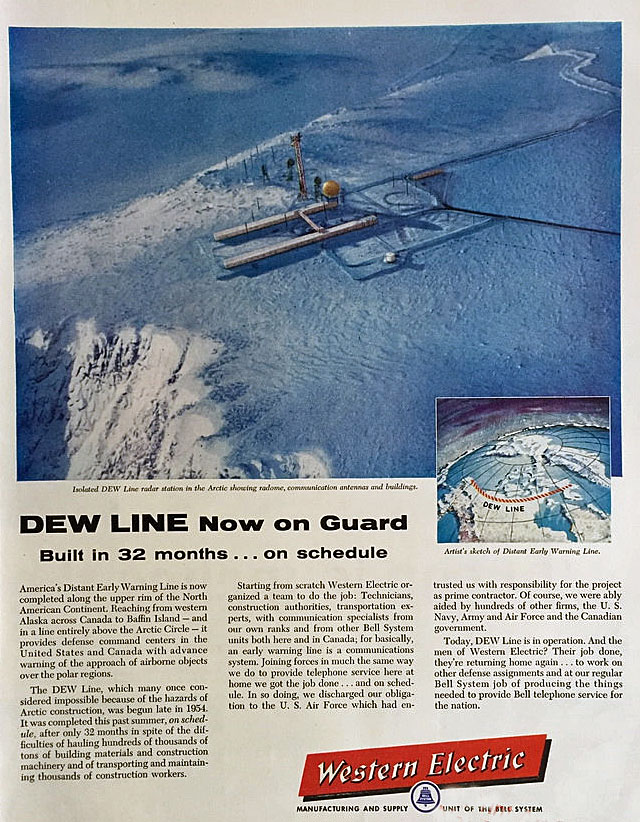
The Distant Early Warning Line was a system of 63 radar stations built across the Arctic Circle to detect Soviet bombers. Constructed by Western Electric, it extended 3,000 miles along the 69th parallel from Alaska to Baffin Island. The Arctic Institute of North America estimated it took 25,000 workers and $300 million to build the stations.

The U.S Air Force took operational control of the DEW Line on July 31, 1957, two months before the Soviet Union launched earth’s first man-made satellite, Sputnik.

This magazine ad appeared shortly after completion of the system.

Jeff Widmer’s latest book is Distant Early Warning, a novel of the Cold War.

The sound of the Cold War

One of the most fascinating aspects of Cold War spy craft is the most innocuous-sounding: numbers stations. They broadcast seemingly random strings of numbers or letters over shortwave frequencies. The broadcasts are received by agents embedded in other countries. Because the signals are one-way, spies are able to hear and decode the messages without fear of radio-tracking.

Originating during World War I, numbers stations proliferated during the Cold War, that period of tension between eastern and western powers from 1947 through 1991.

In the novel Distant Early Warning, Wil and Glenn Andersen believe these broadcasts are aimed at a spy operating in their neighborhood.

This is what the boys might have heard on their shortwave receiver. It is a recording of a woman reading a string of numbers in German. The numbers were often read in groups of three, four, or five. The file comes from The Conant Project on SoundCloud. The Conant Project consists of dozens of recordings of numbers stations from around the world, available for listening or download. (For a look at contemporary use of the stations, see the Numbers Stations Research and Information Center.)

Soviet spy radio set (Eagle) Mark II R-350M. (Photo by Maksym Kozlenko. Used with permission under Creative Commons license.)