But our intentions were good

Our writers’ group had a discussion this morning about the use of AI to generate content. Is it a high-tech form of plagiarism? Does the work to which it is applied constitute original art? Digitally generated voices have already rendered obsolete the narrators of audio books. Will AI do the same to writers?

To illustrate the dilemma, one of the authors said he was astonished at the accuracy and sophistication of the answers he’d received after asking Microsoft’s AI assistant to summarize the chapters of his memoir. He’s about to pitch the book to an agent and was looking for a convenient way to describe the work.

Another writer said she’d used AI to generate a summary for the back cover of her memoir and felt pleased with the result.

I’ve used AI for research but never for pitching or publication. So, when the meeting ended, I uploaded the text of my first novel and asked Microsoft’s Copilot to write a summary for an agent. It might have taken 18 seconds to get an answer. It wasn’t what I’d expected.

I’ll let you judge whether it’s appropriate. But first, some background.

Peak Season is the first in a series of crime novels featuring a former police officer turned real estate agent and a retired state trooper who virtually lives on his boat along the Gulf Coast of Florida. It is a mystery novel, popular fiction that tackles a number of contemporary issues such as property rights and the environment.

I pitched the manuscript to a number of agents. This was before ChatGPT and other large-language models came into vogue, so my email was entirely human-generated. Here’s what I sent:

Dear [agent’s name redacted]:

She’s the wrong person in the wrong place at the wrong time.

Responding to a domestic disturbance, CW (Candace) McCoy is forced to shoot a fellow police officer to prevent the death of his wife and child. Internal affairs rules the shooting justified. CW can’t and fears she’s inherited the killer gene from her father. Refusing to carry a gun, she quits the force and escapes to Southwest Florida to sell real estate, care for the grandfather who took her in after the murder of her family, and silence the demons that threaten her new life. But even in paradise during peak tourist season, there’s no outrunning bad blood.

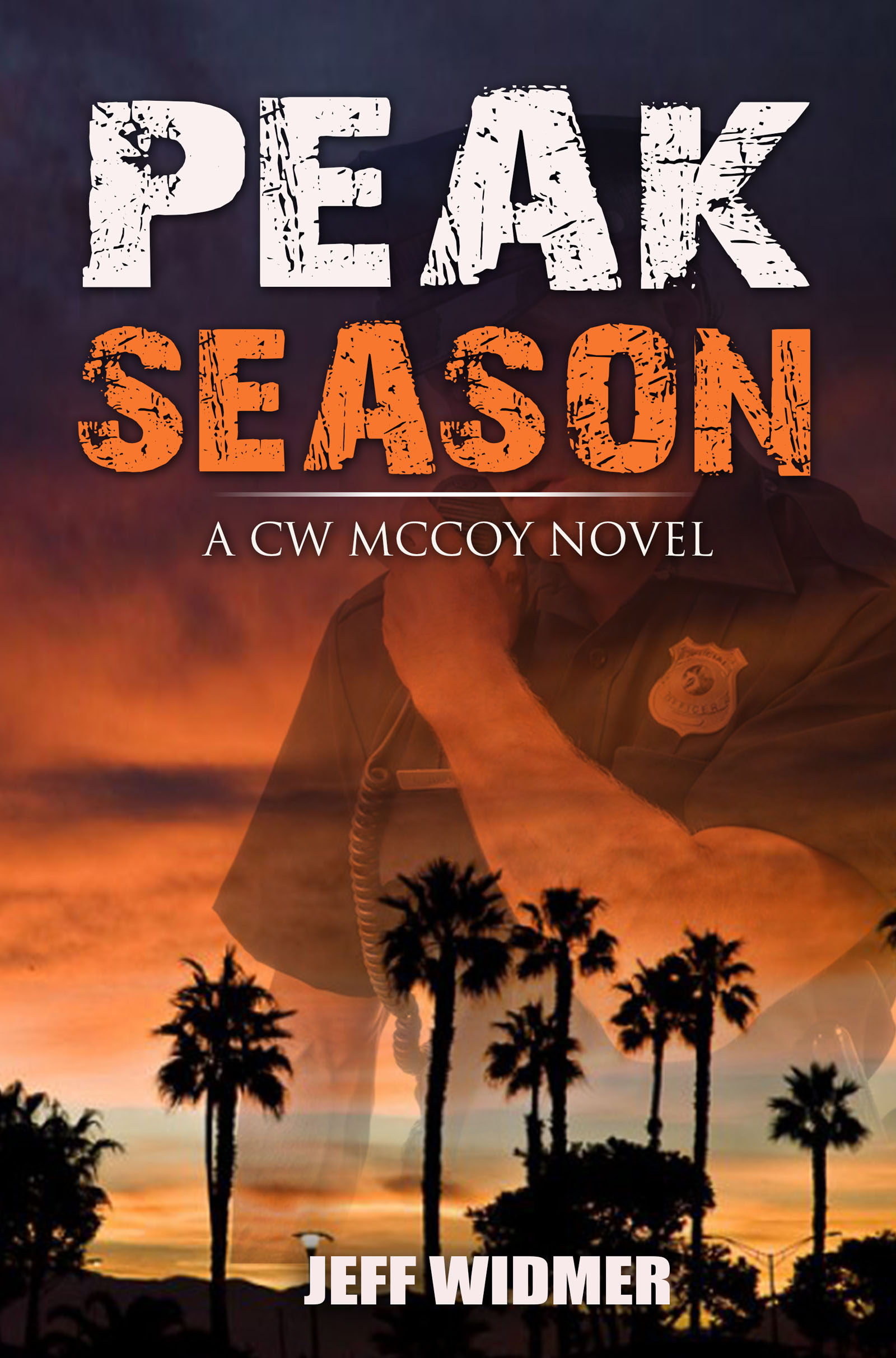
Original book cover

Declared dead by the courts, Bobby Lee Darby appears in CW’s office to demand the family friend clear his name in a scheme to bilk millions from investors. When CW refuses, the fugitive financier kidnaps her grandfather and triggers a chain of burglary, assault, and murder that convinces local police the former cop has gone rogue.

Racing to find Darby and her grandfather, CW must confront her violent past, risky affairs, and love-hate relationship with Florida before those personal demons turn her new-found paradise into hell on earth.

A former journalist with Dow Jones, I am the author of The Spirit of Swiftwater and other books, with an eponymous website (jeffwidmer.com) and an extensive social network.

Since you look for new voices in women’s suspense and represent [authors’ names redacted], I think the CW McCoy series would make for a good fit with your agency.

I’ve included the first three chapters below. Would you like to see the complete 72,000-word manuscript and the first chapter of the second book in the series?
OK. Despite my heroic effort, that letter didn’t work, and I wound up independently publishing the novel in 2014. But what if I were to pitch a rewrite and use AI to generate the query letter? When I fed the text of the entire manuscript into Copilot, I got this:

Dear [Agent Name]:

I am thrilled to introduce Peak Season, a novel that captures the electric tension between fleeting beauty and the transformative impermanence of life. Set in a sun-drenched coastal town where every summer day burns with both promise and poignancy, this story follows [Protagonist Name], a determined soul navigating the dizzying interplay of desire, loss, and rebirth. As the town swells with the vibrant energy of peak tourist season, long-hidden family secrets, unexpected romances, and personal reckonings emerge, forcing our heroine to confront the true cost of chasing a dream—even when that dream burns as bright as the midsummer sun.

AI-generated cover

At its heart, Peak Season is a deeply atmospheric exploration of the human spirit. It invites readers to savor the bittersweet cadence of relentless change: the ephemeral thrill of new beginnings and the heart-wrenching inevitability of endings. Through lyrical prose and raw, immersive storytelling, the novel paints an intimate portrait of individuals who, like the turbulent coastal tides, are in constant flux—seeking meaning in moments both fleeting and profound.

I believe that Peak Season will resonate with readers who appreciate literature that not only entertains but also challenges them to reflect on the impermanence and intensity of life. Its richly woven narrative and authentic emotional depth offer a fresh voice in contemporary literary fiction—a voice destined to captivate audiences in today’s dynamic literary landscape.

Thank you for considering this submission. I would be delighted to send you the full manuscript and discuss how Peak Season can find its place among today’s most compelling literary works.

Warm regards,

The transformative impermanence of life? I’ll accept raw, immersive storytelling. Even a fresh, contemporary voice. But literary fiction? A bridge too far, and an inaccurate reading of the tone of the book, which is more Chandler and Evanovich than Proust or Joyce.

But enough of my views. What do you think? Is AI the shortcut to greater productivity and happiness or a Trojan Horse we’ll live to regret?

Ask your computer or phone. They’ll know.

Everything Old is New Again

It’s easy to blame Amazon.com for the downfall of on-site shopping, but there are larger social forces at work, generational and technological shifts in how people buy and move their goods. Still, many of the shrines erected to shopping over the last half-century stand empty, a testament to the continued migration to the digital world.

The enclosed shopping mall began life in the mid-1950s in Sweden, Wisconsin, and New Jersey, part of a movement from urban flight to suburban sprawl. The rest of America followed.

In the Gulf Coast resort town of Sarasota, Florida, the Sarasota Square Mall opened on September 28, 1977. Forty-six years later, it lies virtually empty of anyone except walkers seeking shelter from the sun. During its heyday, it featured more than a million square feet of shopping with storied merchants such as Macy’s, Sears, and JCPenney, a 12-screen AMC Theatres, and—as an add-on—a Costco. As late as 2019, the mall’s website listed 44 stores and other businesses. Today, only AMC, Costco, and two restaurants in the food court remain.

Plans to redevelop the mall into everything from senior housing to county offices have floated for years. The current owner, Torburn Partners, wants to build 1,200 apartments on the site, with grocery, retail, and restaurant space. JCPenney, Costco, and AMC would remain.

Everything old. . . .

Defeating ‘the American Plague’

Yellow fever doesn’t have the cachet of the Black Death or the Asian flu, but the mosquito-borne disease nicknamed “the American Plague” has tormented the world for centuries.

The U.S. Centers for Disease Control and Prevention estimates the virus causes 200,000 cases and 30,000 deaths each year, and not just in the tropics. The disease first struck New York City in 1668, followed by at least 25 major outbreaks in the Americas, including an 1878 epidemic in the Mississippi River Valley that killed 20,000 people.

There is a vaccine, developed after the opening of the Panama Canal in 1912 by scientists throughout the world. However, historically it needed to be freeze-dried, a process prone to mechanical issues until it was refined in the early 1950s by National Drug in the small hamlet of Swiftwater, Pennsylvania.

You can read the story of this and other vaccine innovations in The Spirit of Swiftwater, a chronicle of the pioneers of immunization who fought to revolutionize healthcare in America.

An outbreak of innovation

The Spanish flu outbreak of 1918 wasn’t the first pandemic to sweep America.

In the late 1800s, smallpox ravaged the nation. In New York City, the mid-century death rate from the disease hit 21.9 people per 100,000. In nearby Pennsylvania, by 1900 the disease had killed thousands.

There was a vaccine. And it worked. Some of the time. And there were side-effects.

The solution? A cross-cultural effort that combined French ingenuity with American innovation.

You can read the full story in my first book, The Spirit of Swiftwater, a chronicle of the pioneers of immunization who fought the odds to revolutionize healthcare in America.


For business, the high cost of high tide

The tide is shifting. The debate over global warming has moved from theoretical to practical. As in, what is the cost of climate change to businesses and, eventually, to all of us?

Real estate agents find themselves at the heart of the issue. Anything that affects property values affects their livelihood. So it’s encouraging to see a call to action from one of their own.

Craig Foley, chair of the National Association of Realtors’ Sustainability Advisory Group, says that ignoring the impact of climate change on real estate has serious business implications. “Particularly in coastal areas, members have told me both they and their clients are worried about declining property values and buyer interest.” The piece, entitled “We Don’t Have 50 Years to Wait,” appears in the March/April 2019 issue of Realtor magazine.

In case you think that’s the hype of tree-huggers, Foley backs his observation with well-credentialed statistics. “Researchers at the University of Colorado at Boulder and Pennsylvania State University compared properties that are similar except for their proximity to the sea and found that the more exposed homes sold for 6.6 percent less than the others during the sample period from 2007 to 2016.”

Foley ends his commentary with this thought: “As I see it, we can’t afford to be on the wrong side of history on climate change.”

That captures a core issue of Permanent Vacation, a novel in which the protagonist, real estate agent CW (Candace) McCoy, discovers that encouraging construction in a flood zone is a sure way to sink a career.

You can read Foley’s commentary here. If you buy or sell real estate and have a comment on this or any other issue, you’re welcome leave it here as well.


A rising tide floats all buildings

Sometimes reality catches up with fiction.

Yesterday, a Florida Senate committee advanced legislation that would require the state to plan for rising seas. The action comes after storm surge has repeatedly flooded parts of Miami and threatened its infrastructure.

The proposed legislation is unique in that it avoids the politically divisive issue of climate change and addresses the economic aspect of rising sea levels.

Lawmakers aren’t alone in considering the financial impact of coastal development. The economics, and ethics, of building in flood zones form the central premise of Permanent Vacation, a novel set in a fictionalized version of Sarasota and Bradenton, Florida, both of which border the Gulf of Mexico. Central to that issue is whether governments should encourage or discourage behavior that puts people and property at risk.

Permanent Vacation is available from Amazon, Apple Books, Barnes & Noble, Kobo and Smashwords. You can read the story about Florida lawmakers here.

Stars and Stripes and Sousa forever

John Philip Sousa III (1913-1991) did not follow in the footsteps of his grandfather, but those who met him discovered a spirit as creative as the famous march king. I interviewed Sousa the younger in the summer of 1987, when he visited Delaware Water Gap, Pennsylvania, for a concert in honor of the man who wrote what many consider to be America’s second national anthem.

John Philip Sousa III marches to the beat of a different drummer than his famous grandfather. It isn’t that the New York City resident doesn’t thrill to the stirring marches of his illustrious forbearer. It’s just that he’s more inclined toward the written word.

“I love hearing them,” Sousa said of the marches during a concert featuring “Semper Fidelis,” the Marine Corps anthem, and other favorites. “But writing always has been my enthusiasm.”

The New York resident is the author of two books, both nonfiction, of which one was a bestseller. He was assistant publisher of Fortune and formerly head of public affairs for Time magazine and in charge of long-range development for the Time-Life Book Division.

“Right now, I’m writing a book on good taste in management,” he said. “Then I think I’ll write my memoirs.”

John Philip Sousa III relaxes during a concert in honor of his grandfather

He is also head of the Sousa Foundation, which controls the rights to his grandfather’s work, although he admits that, when he was young, he wasn’t aware of the music.

“I paid no attention to it at all. As far as I was concerned, he might not have existed. Then, when a certain aunt died, I got stuck with the whole Sousa Corporation. It’s just something I have to do every day. I think I owe it to my grandfather.”

As a youth, Sousa may not have been familiar with the music, but he has fond memories of his paternal ancestor.

“He was charming, relaxed. He had a good sense of humor. He smoked cigars all day long, but back then, it was good for you.”

The elder Sousa wore mismatched clothes and “always had a piece of music in front of him.”

He’s familiar with the music now. “I love it. I have the same favorites everybody else does, ‘Stars and Stripes Forever’ and the ‘Washington Post March.’” But one piece stands out. “It’s ‘El Capitan,’ from the operetta. He wrote 20 operettas, you know.”

Although Sousa has heard the marches hundreds of times and is used to the fireworks and fanfare, he still marvels at the reception with which audiences greet his grandfather’s music.

“Last summer I was in [New York’s] Central Park for a concert with Leonard Bernstein. There were about 100,000 people there. They cheered and applauded him and he played a number of his own compositions, but they wouldn’t let him go. And finally he turned around and what did he play? ‘Stars and Stripes Forever.’”

During a speaking engagement in Toledo, Sousa was asked about the connection between John Philip Sousa and the Fourth of July. “I said, ‘Funny you don’t know that. He invented the Fourth of July.’”

Does he see a resurgence in Sousa’s popularity together with heightened interest in patriotism?

“No, they are just good marches. Yes, they make everybody cheer and clap, but if the marches weren’t that good, everybody wouldn’t be cheering and clapping.”

Sousa saves his sentiment for other things. He will not divulge his age. He will not even discuss it. Once, when he bought a ticket on the Long Island Railroad, the ticket agent asked if Sousa was over 65 and eligible for the discount rate.

“I asked for a ticket, not a discussion of my age,” Sousa fired back.

He seemed more relaxed at a tribute to his grandfather’s music in the tiny borough of Delaware Water Gap, Pa., lounging in a director’s chair in a white suit that matched his hair. “I thought it over and the concert just sounded so enchanting, with everybody up here knocking themselves out. And it wouldn’t kill me to come up, you know.”

Sousa appreciates music but never learned to play an instrument. “I blame this on my mother, if blame is the right word. She couldn’t carry a tune. Talking to myself I said, ‘He did it better than anybody. Do something else, John.’ So I did.”

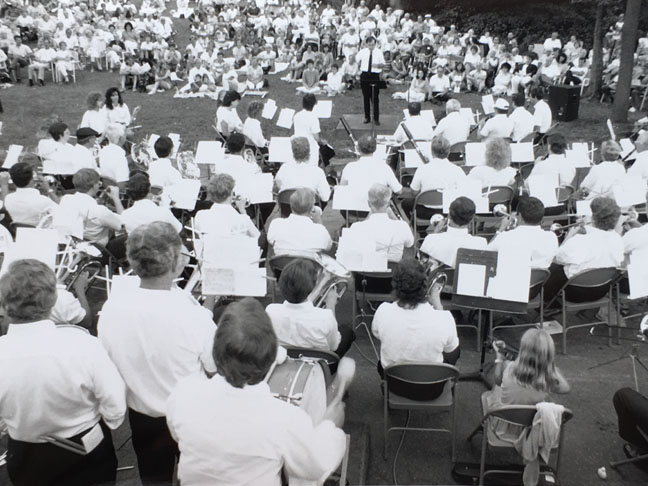
Pat Dorian directs the band on Aug. 20, 1987, 75 years to the day when John Philip Sousa conducted a similar concert on that spot in Delaware Water Gap, Pa.

Playing it safe

The National Association of Realtors has been at the forefront of promoting agent safety. The organization’s Realtor Safety Program website offers several resources for agents as well as background on why a personal safety plan is important. It also provides a context for buyers and sellers who may see some of these precautions as inconvenient or unnecessary.

One of the most accessible tools on the site is the video “Real Estate, Safety, and You,” through which consumers can learn about the safety protocols they may encounter when working with an agent.

(In Curb Appeal, fictional real estate agent CW McCoy breaks it down into the Three C’s: set the initial client meeting in the office, copy their drivers’ licenses and, when showing the property, never get cornered.)


Eradicating ignorance

We take vaccines for granted. We get our shots as kids and forget about the process until we have children of our own. In the Western Hemisphere, we generally don’t see the diseases that plague the Third World. We call them preventable.

A hundred years ago, the science of immunology was struggling, and so were its advocates. Just before Dr. Richard Slee was born in 1867, the French biologist Louis Pasteur had proven the germ theory of disease. It wasn’t until 1885 that Pasteur field tested his vaccine for rabies.

Twelve years later, when Slee built his laboratory to manufacture smallpox vaccine in Swiftwater, Pennsylvania, the disease was still considered a major threat to public health. It would not be eradicated worldwide until 1980. To complicate the issue, the technology of the time caused some of those patients to become ill. Because of those adverse reactions, vaccines of the time stimulated fear as well as immunity.

Some things haven’t change.

In Minnesota, 73 cases of measles have been confirmed this year, three more than the Spirit of Swiftwatertotal for the entire country last year, according to data from the U.S. Centers for Disease Control and Prevention and the Minnesota Department of Health.

The CDC and the World Health Organization also are concerned with the rise in the number of cases of mumps, polio, rubella, whooping cough and other vaccine-preventable diseases.

How did Dr. Slee manage to eradicate smallpox in America? And how has the science of infectious-disease prevention progressed over the last century?

You can follow the struggles and triumphs of the people who shaped modern medicine in The Spirit of Swiftwater, a history of vaccine development in the twentieth century. The book chronicles the pioneers of immunization who fought against the odds to establish this form of health care as standard public policy in America, with a focus on the U.S. operations of sanofi pasteur, the vaccines business of sanofi-aventis Group. Reviewers describe the work as “a thoroughly documented historical perspective of the vaccine industry in the US as seen through the history of one of its leading contributors that is also entertaining reading.”

Now, if you’re really ready for a Horatio Alger story with a medical spin, take a look at One in a Million by Mary G. Clark. In this ghosted memoir, Mary tells the story of how she took her wound-care company from the coal fields of Scranton, Pa. to the NASDAQ. The book starts with a touch of mysticism and ends with science, a fitting story for our times.

Lend us your friends’ ears

Audible has a new service called Clips. It works like bookmarks do in e-books and web browsers, with a feature for the sharing economy.

Here’s how.

Audible clipsFirst, you have to have the latest app for an iOS device. Then, when you hear a passage you’d like to share with others, tap the Clip icon, move the start and end points and save it the snippet, or share via email or social media.

Saving the clip allows you to return to that spot for a repeat performance. Benefit to you. Sharing the clip amplifies Audible’s marketing and might eventually put a few more pennies in the pockets of its authors and narrators. Game, set and match to Audible.

But before grow too critical, I’d like listeners to try the service on one of my audiobooks, Peak Season or Mr. Mayhem, depending on whether you like a strong female lead or a crazy disgraced journalist nattering in your ear for seven hours.

Speaking of nattering . . . let me know what you think.